

2018.11.11 13:12
This article was taken from Providence Journal on Veterans Day November 11, 2018
Jeff Mead tried to convey what it’s like to be in war.
He was speaking Saturday to 100 or so folks at Middletown Town Hall for a Veterans Day forum.
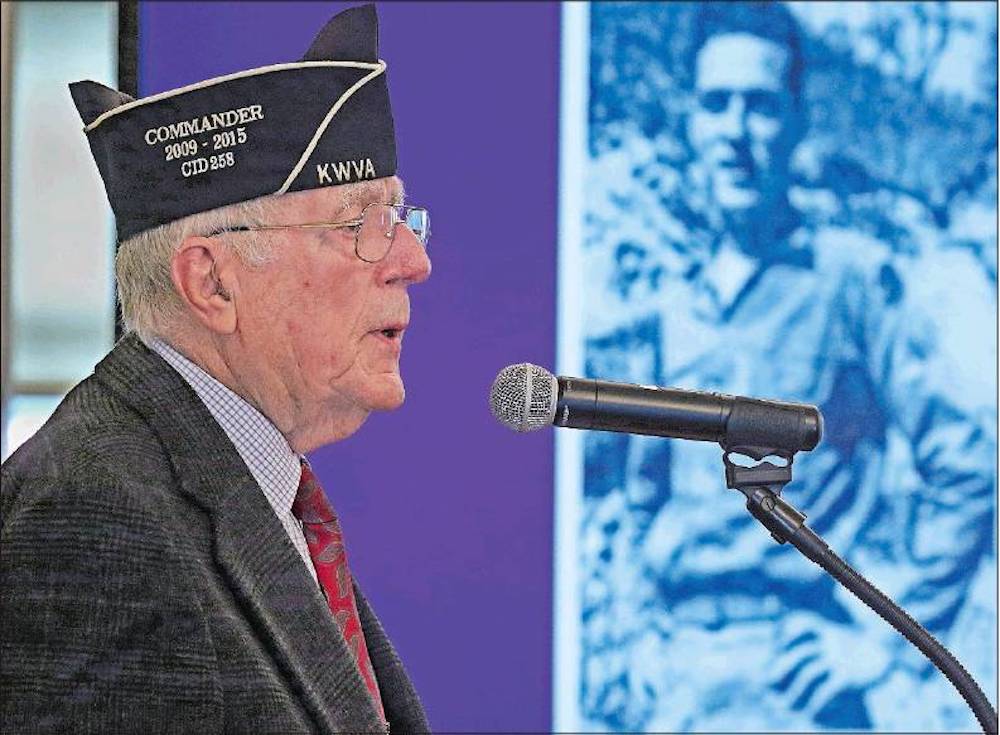
He told them of being in Vietnam in the late 1960s, operating radar equipment on high ground targeted by mortars. From the podium, he pointed to a wartime photo of himself and said the person pictured there never returned — in body, yes, but not mind.
“I don’t think any of us who go to war come back the same person,” said Mead. “It changes you as a human being.”
Dick St. Louis also took a few minutes at the podium. He served in Korea in the early 1950s and spoke of the disorientation of being shipped around the world to war.
Suddenly, from his Seattle base, he was on a transport plane to Japan, then a train to a port, a barge to Korea, and finally trucked to the battle zone in the dead of night.
“Hey soldier,” he was told as he stepped down, “get a little shut-eye because that’ll be the last time you get a rest until you go home.”
The forum was the idea of Providence VA Medical Center staff psychologist Nathan Stein. He knows it’s common for veterans to carry their burdens alone, so he recruited 15 to share what it’s like both to go to war and to come home.
Butch Warner, a Marine infantryman in the late 1960s, was assigned soon after arriving in Vietnam to help get fellow troops and their equipment onto a ship.
“What I didn’t know,” he said, “is the body bags came up first.”
He spoke of jungle ambushes coming out of nowhere, and the time his rifle jammed during one. He talked of serving his country and what it was like to then be rejected at home instead of welcomed.
“You didn’t dare tell anybody you were a Vietnam infantry vet,” said Warner.
That’s different now, but Air Force veteran Denise Miller, who was deployed to Afghanistan, said there is a subtle lack of acknowledgement for many like her.
“People don’t think of a veteran as a female,” she said. “I just want people to know we’re out there, too.” Shawn Sexton, a Marine who served in Afghanistan, spoke of the things veterans give up — like hot showers and hot meals for months on certain missions. He missed Christmas back home, his wedding anniversary, Thanksgiving, and the birthdays of his two children.
And when your kids are young, he added, it takes time after you return for them to get to know you again.
Joe Kaiser was an Army combat medic in Iraq often helping treat locals. There was gratitude, and he believed in the mission of trying to make that country safer. Yet in such a war, he told the audience, there is the stress of knowing many there woke each day wanting to kill Americans.
Jerome Jordan, a Navy corpsman from 2007 to 2015 treating everything from gunshot wounds to battle stress, said he developed PTSD himself at home but wasn’t aware enough to diagnose it.
“I needed help from people who loved me,” he said.
There’s a stigma in acknowledging PTSD, he explained, and the veteran often needs family and professionals who can see it.
Then there was Jake Emmott, a Navy field medic from 2007-2010 deployed to both Iraq and Afghanistan. He spoke of the rewards of helping rebuild a country, remembering the day he was on security in Iraq and saw an endless line of locals waiting to vote because Americans had made it possible.
“Knowing I had a hand in that was incredible,” Emmott said.
Then he gave an insight into what things are most important to those who serve.
“I was on combat patrol,” he said, “and was shot in the face.” The bullet went in by the right side of his nose and exited by his left ear.
But something else, he said, was worse than being wounded — being separated afterwards from his brothers-in-arms in Afghanistan.
Stephen Amaral served as an Army artilleryman from 1992 until 2013, with two tours in Iraq and one in Afghanistan. He left the audience with an appeal that resonated.
“Be aware of your forces,” he said. “Know where they are. Thank them for their service.”
Such simple words, he said, help veterans believe their sacrifices were not in vain.
Mark Patinkin, Providence Journal Columnist


